Written by G Robinson
In 1735, Francis Barber was born as an enslaved person in Jamaica, meaning that his mother was an enslaved person at the time of Barber’s birth. According to an article by Herts Memories, in around 1750 Barber was brought to England by Captain Bathurst, a plantation owner. Bathurst's son was friends with Dr Samuel Johnson and when Johnson's wife died, Barber was sent to live with Johnson to be his valet.
When Bathurst died, he wrote in his will that Barber should be given his "freedom". However, it is important to note that even people who had been given "freedom", were not always truly 'free'. Black people were subjected to inequality and racism, and faced dangers of being captured and enslaved, even if they had been 'given freedom'. Barber remained Johnson's unpaid servant, demonstrating that he was not treated justly and did not have true freedom as he was not paid for his work. Furthermore, according to Herts Memories, Barber tried to run away twice which could suggest he was not happy there and yearned for true freedom.
In 1767 Barber was sent to school in Bishop's Stortford, Hertfordshire. Johnson paid an expensive £300 in school fees. This begs the question, why did Johnson pay for Barber's schooling, but did not pay him a wage for his work as a valet?
There is a record dated 1769 which shows Barber bought a hat which cost 8s 6d, paid for with Dr Johnson's money. The record reads: "Mr Barber at Mrs Clapes a hatt". "Mrs Clapes" refers to the college at the Bishop’s Stortford school in which Barber attended. The record also shows that other students bought hats the same day. In another letter written from Samuel Johnson to Barber, Johnson references "Mrs Clapp" and once again mentions Barber. 8s, 6d was just over a week’s wages at that time and is the equivalent to £37.08 in today’s money.
Later in life, Barber set up his own school in Staffordshire, possibly making him the first Black schoolmaster in England. The article by the Herts Memories considers the possibility that Francis Barber's experience at school in Bishop's Stortford may have inspired him to set up his own school in Lichfield, Staffordshire.
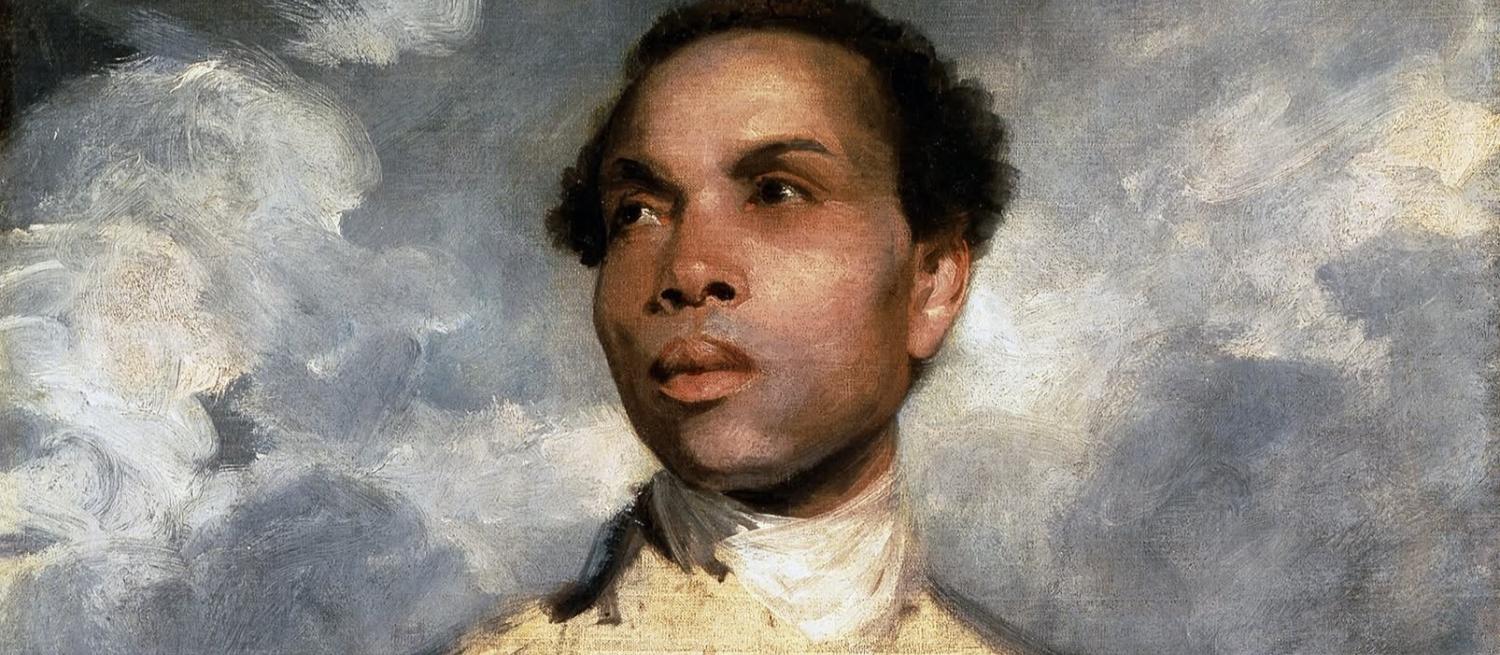
There is an oil painting thought to depict Francis Barber. Sources have estimated that the original portrait dates back to 1770. The Tate website describes how the portrait “is one of many student copies of a painting by Joshua Reynolds”. According to the Tate website, “Previous titles, including A Young Black Man, may suggest that as a Black man, Barber was being treated as an artistic subject, rather than as an individual”. At the time many Black people were wrongly objectified as ’exotic’ and so this painting could suggest that Barber may have been treated this way.
The artist has portrayed Barber in a white cravat or ascot, with short hair, which was often the style used for paintings of white aristocrats in 18th century artwork. For example, ‘John Musters’ by Reynolds features a white cravat and similar clouds in the background to those in the portrait of Barber. During the Renaissance period, paintings often featured landscapes and vast skies to portray the lands that the sitters had travelled to. However, Barber had no choice about whether he travelled, making the composition of the clouds all the more poignant.
Could this indicate a loss of Barber’s identity through the painting as he is depicted in a European style? Or was he now considered a middle-class gentleman? Perhaps the painting was commissioned by Johnson, as the portrait is dated just three years after Barber was sent to school and just one year after he purchased the hat for 8s, 6d. Whatever the answers may be, Barber’s story is a crucial part of Hertfordshire’s Black history, and Barber is a prominent figure in his own right as potentially England's first Black schoolmaster.
Barber, J (2010) Francis Barber. Herts Memories [online] Available: https://www.hertsmemories.org.uk/content/herts-history/places/schools/francis-barber
Boswell, J. (1791) Life of Samuel Johnson. UK: Penguin Classics
Staying Home (n.d.) [online] Available at: https://websites.umich.edu/~ece/student_projects/money/workB.htm
National Archives (n.d) Currency Converter. [online] Available at: https://www.nationalarchives.gov.uk/currency-converter/#currency-result
Fofana, (2022) Biringham Live. [online] Available at: The legacy of Francis Barber - Lichfield's first free Black man - Birmingham Live (birminghammail.co.uk)
Barber, J. (2010) Francis Barber. Herts Memories. Available at: ttps://www.hertsmemories.org.uk/content/herts-history/places/schools/francis-b…
Reynolds, J. (1770) Portrait of a Man, probably Francis Barber, The Menil Collection. [painting]Available at: https://www.menil.org/collection/objects/2829-portrait-of-a-man-probably-francis-barber
Reynolds, J. (n.d) Portrait of a Man, probably Francis Barber. [painting] Tate Gallery. Available: https://www.tate.org.uk/art/artworks/reynolds-portrait-of-a-man-probably-francis-barber-n05843
Reynolds, J (1777-c. 1780) John Musters. National Gallery of Art [painting] Available at: https://www.nga.gov/collection/art-object-page.46088.html