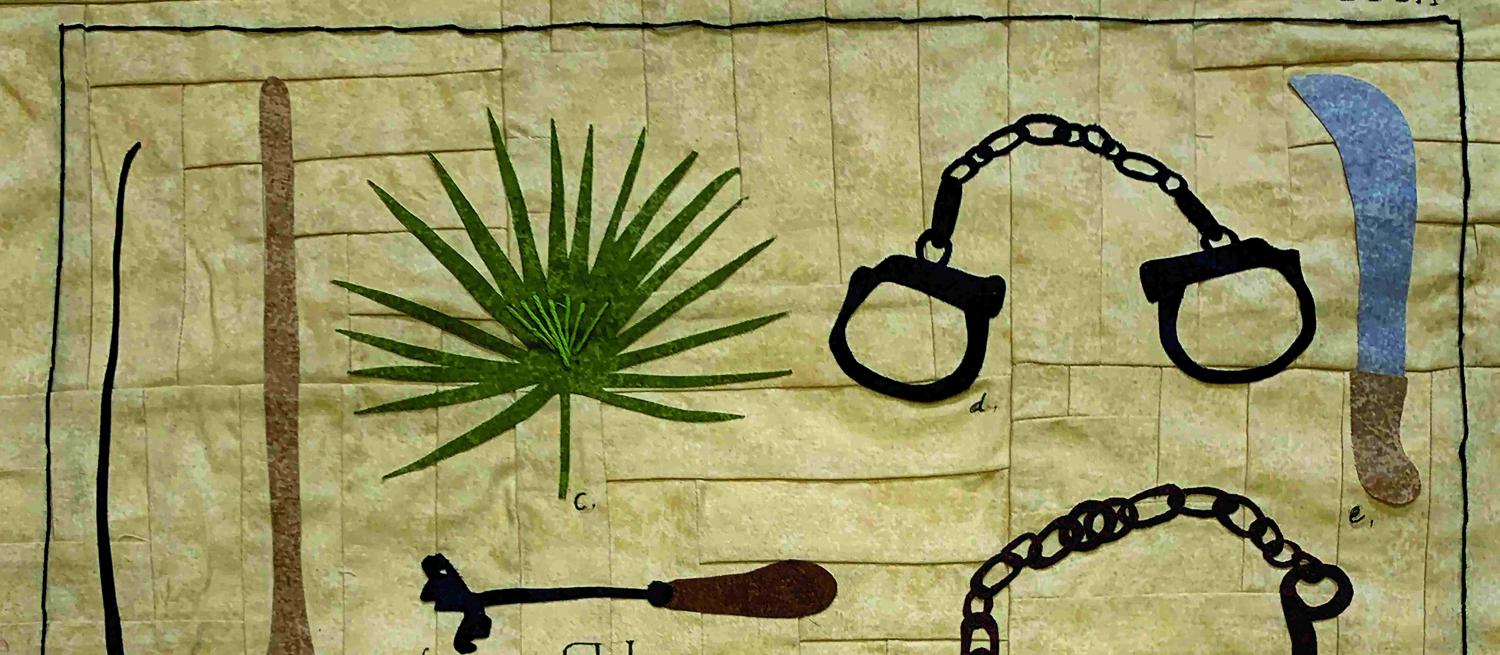
The Making of the St Albans 'Brazilian' Hat (2025) is an artwork by Jahnavi Inniss that was commissioned for the Black History Research Group's exhibition and zine, Our Stories; Tracing Black Histories in Hertfordshire.
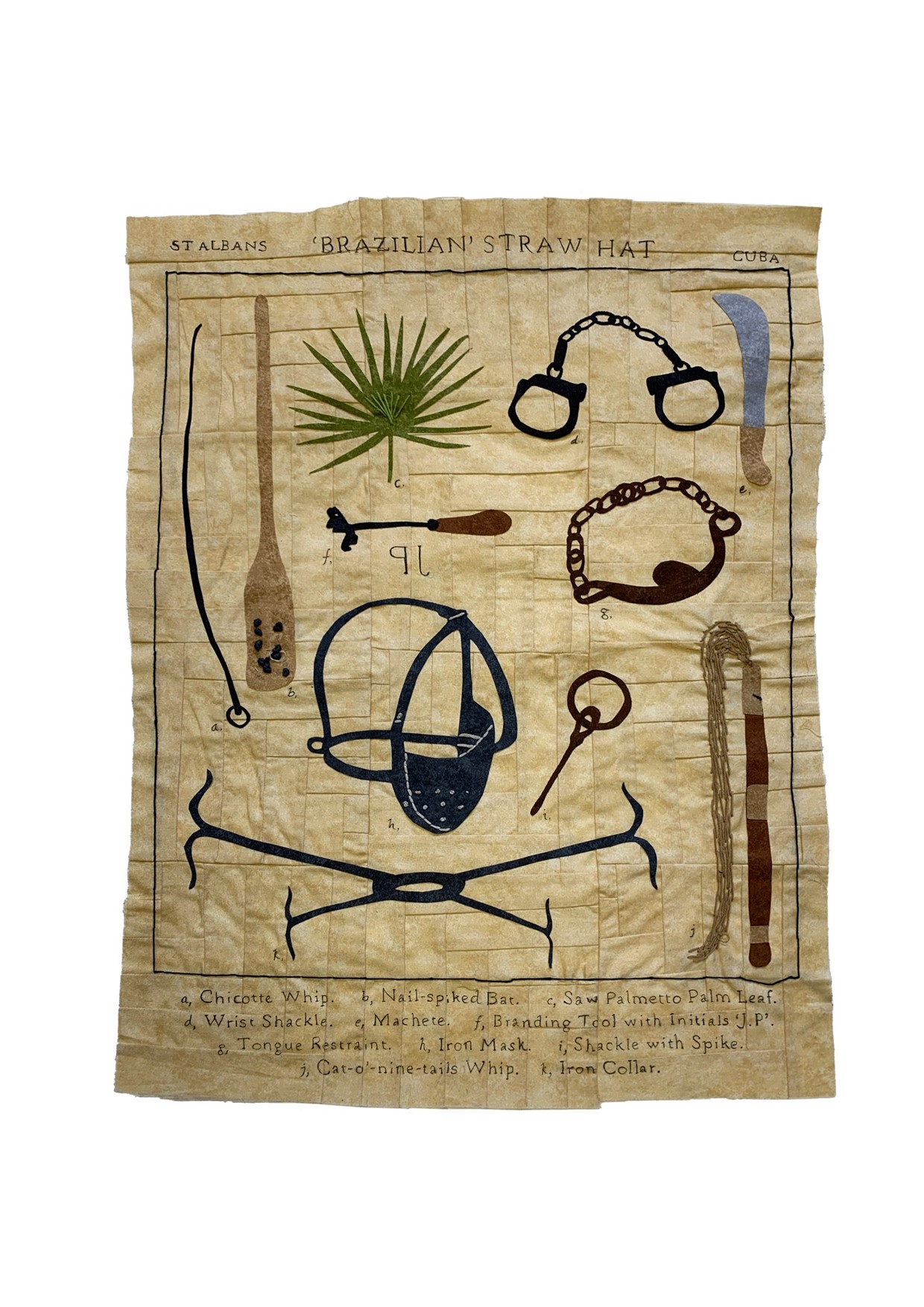
Jahnavi writes: This piece reveals the brutal violence, dehumanisation and exploitation that produced one of Hertfordshire's most treasured heritage objects - the St Albans 'Brazilian' Straw Hat. The harvesting and importation of raw palm leaves, like many other commodities produced in the Caribbean, rapidly developed Britain's 18th and 19th-century industrial era. Depicting brutal objects of punishment and torture enforced on enslaved Africans, this work speaks to one of the many unacknowledged legacies of the Transatlantic Trafficking of Enslaved Africans in Britain.
The Our Stories zine was researched and written by community researchers who make up the Black History Research Group. It charts Black histories of Hertfordshire spanning 2000 years, from Roman Verulamium to the experiences of the community today.
The full zine can be viewed in all St Albans and District libraries, or purchased for £6 from the St Albans Museum + Gallery shop. Free copies are available for schools and libraries in Hertfordshire. Contact museum@stalbans.gov.uk to request a free copy.
You can read the BHRG research that Jahnavi Inniss responded to with her applique and hand embroidered artwork below.
The long shadow of enslaved labour; St Albans and the ‘Brazilian’ straw hat.
St Albans was famous in the 1800s for its hat making trade. It was a significant local employer, with 38 businesses registered here in 1854. The city was particularly proud of its ‘Brazilian’ hats, which were made from imported palm.
But where did that palm come from?
The Liverpool and Bristol shipping records show that between 1850-70, at least 59% of palm leaf imports came from Cuba, and 9% from the USA.
Given that slavery persisted in Cuba until 1886, and in the USA until 1865, much of the imported palm would have been harvested by enslaved people.
This is a local example of the numerous ways in which Britain continued to profit from enslaved labour long after abolition.
Research by Laura Lennard