Excavations at St Albans Abbey revealed that Abbot Roger de Norton was buried in 1291 with his heart in a case inscribed with Islamic text.
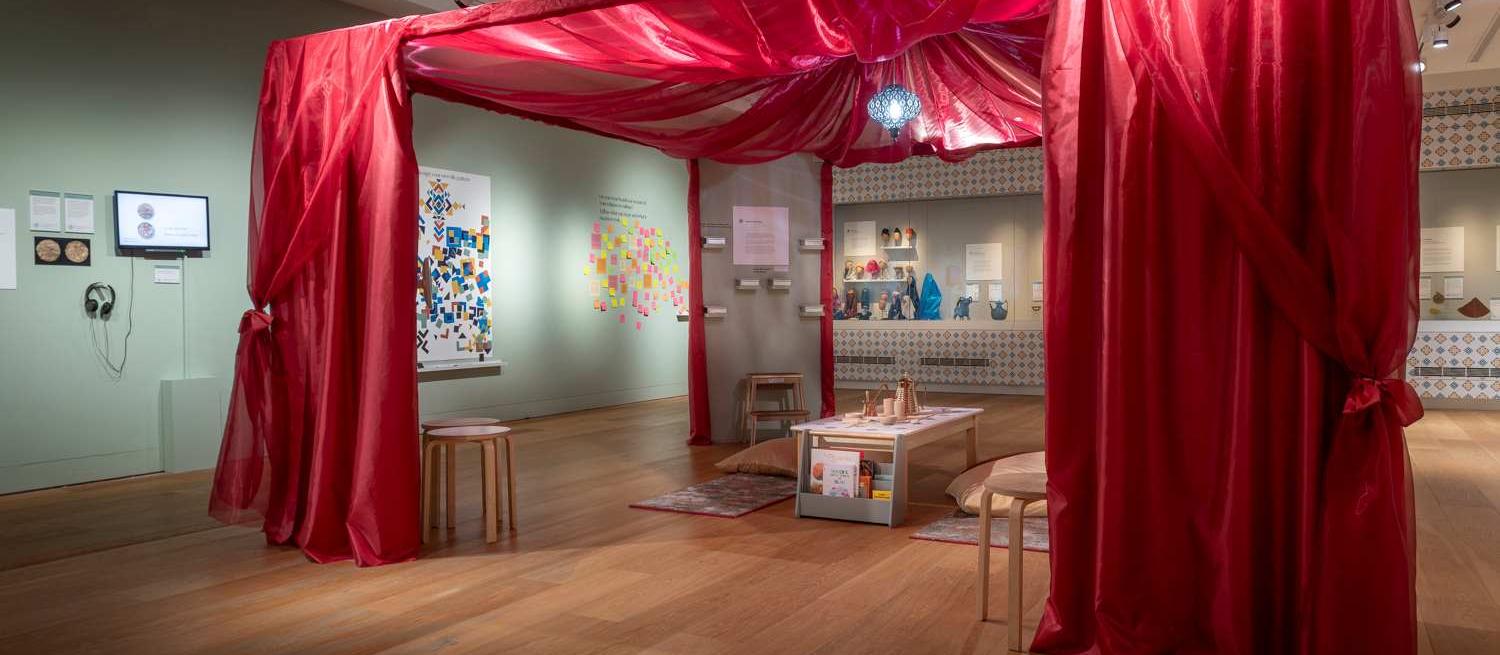
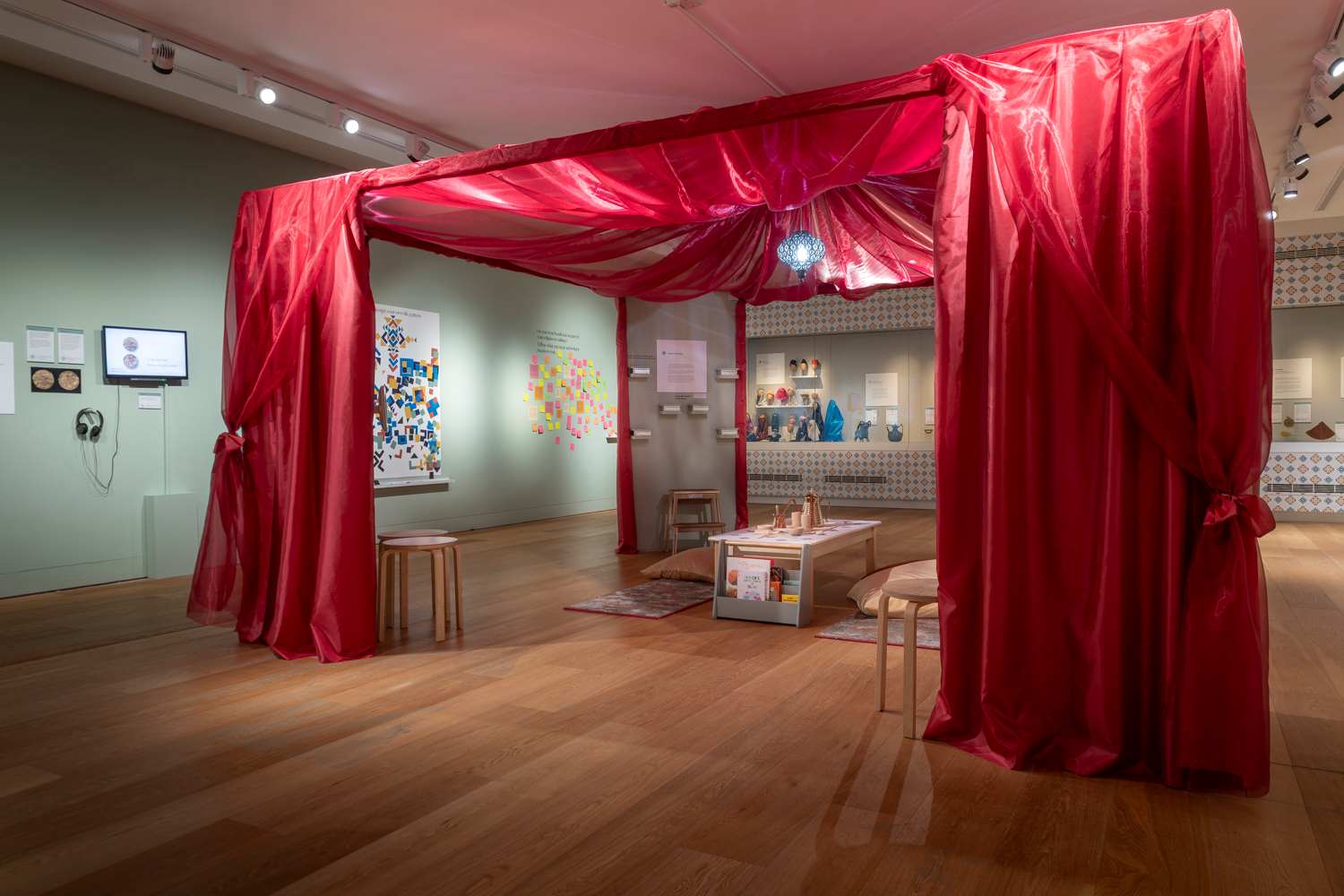
This multi-sensory exhibition explored the many connections (surprising and every day) between St Albans and the Islamic World - from scientific discoveries to a fondness for coffee.
Objects on display included loans from the British Museum, the Whipple Museum of the History of Science, as well as items loaned from members of our community groups, who also contributed knowledge and insights into the history of these objects.
Explore some of the exhibition content below:
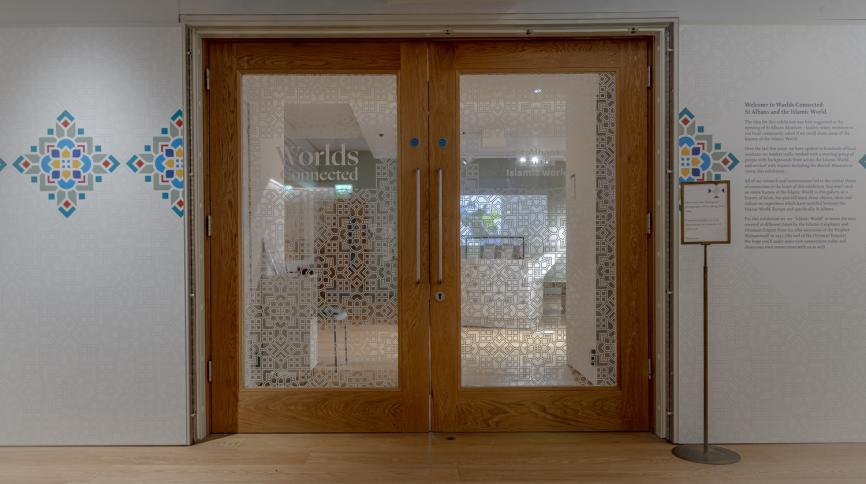
The idea for this exhibition was first suggested at the opening of St Albans Museum + Gallery when members of our local community asked if we could share some of the history of the Islamic World.
Over the last few years, we have spoken to hundreds of local residents on market stalls, worked with a steering group of people with backgrounds from across the Islamic World, and worked with experts including the British Museum to create this exhibition.
All of our research and conversations led to the central theme of connection at the heart of this exhibition. You won’t read about an entire history of the Islamic World, or a history of Islam, but instead about objects, ideas and culture we experience which have travelled between the Islamic World, Europe and specifically St Albans.
For this exhibition we use “Islamic World” to mean the area covered at different times by the Islamic Caliphates and Ottoman Empire from 621 (the ascension of the Prophet Muhammad) to 1922 (the end of the Ottoman Empire).
The Heart Case of Roger de Norton – a direct connection
St Albans Cathedral
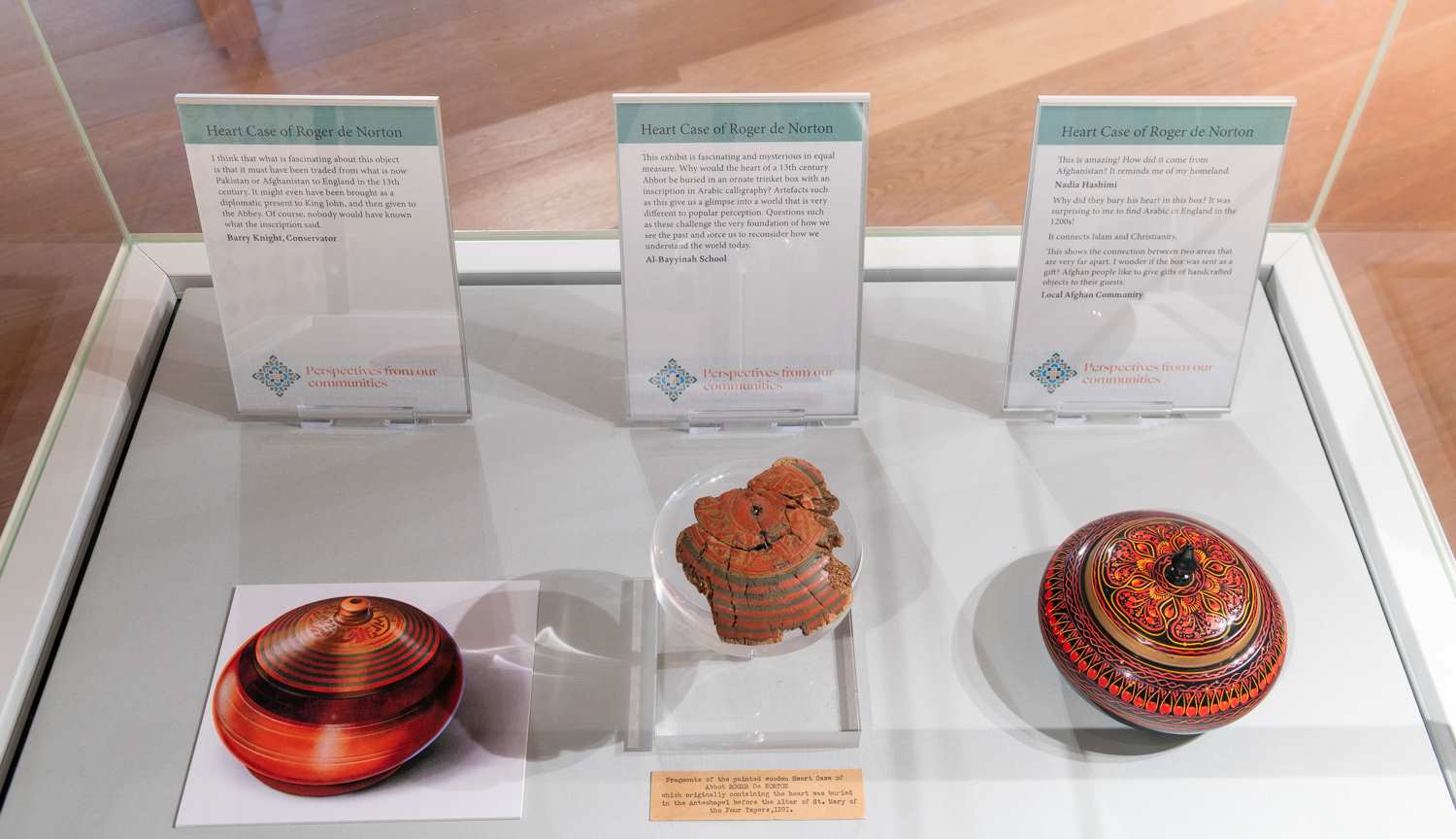
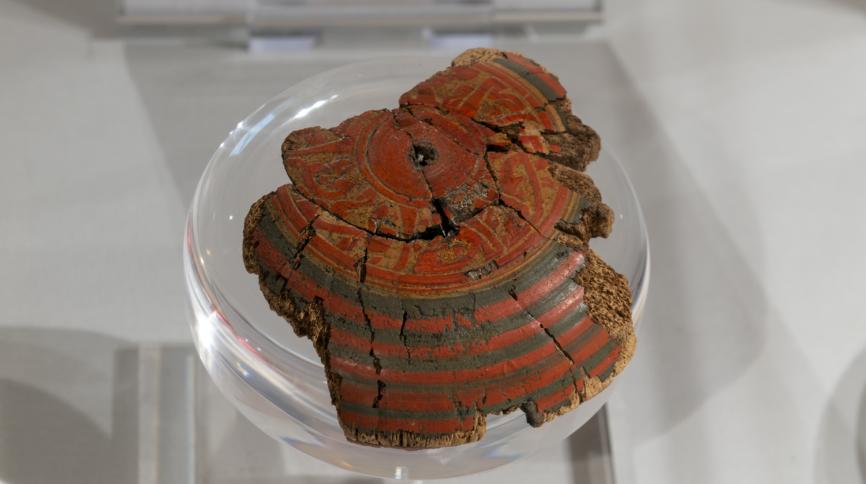
In 1872, works in the Chapel of the Four Tapers at St Albans Abbey (now Cathedral) uncovered this fragment of a box with Arabic text across its lid. Research showed that the box had been buried holding the heart of one of the medieval abbots, Roger de Norton, who died in 1291.
Based on the research of Dr Barry Knight, the box is most likely to have originated in the region that is modern Afghanistan and was likely made in the 1000 – 1100s. The most plausible reading of the fragment of Arabic is al-ʿizz al-dāʾim wa-al-[iqbāl] lahu, or Everlasting glory and [good fortune] for him.
In 1213 King John sent envoys to Emir Murmelius of Morocco and one of these envoys, Robert of London, became Guardian of St Albans Abbey and brought gifts and jewels he had been given by the emir to St Albans. Was the heart case one of these, or had it travelled via the Silk Road through traders and pilgrims to come to St Albans? We will likely never know.
Heart Case Community Text
I think that what is fascinating about this object is that it must have been traded from what is now Pakistan or Afghanistan to England in the 13th century. It might even have been brought as a diplomatic present to King John, and then given to the Abbey. Of course, nobody would have known what the inscription said.
Barry Knight, conservator
This is amazing! How did it come from Afghanistan? It reminds me of my homeland.
Nadia Hashimi
Why did they bury his heart in this box? It was surprising to me to find Arabic in England in the 1200s!
It connects Islam and Christianity.
This shows the connection between two areas that are very far apart. I wonder if the box was sent as a gift? Afghan people like to give gifts of handcrafted objects to their guests.
Local Afghan community
This exhibit is fascinating and mysterious in equal measure. Why would the heart of a 13th century Abbot be buried in an ornate trinket box with an inscription in Arabic calligraphy? Artefacts such as this give us a glimpse into a world that is very different to popular perception. Questions such as these challenge the very foundation of how we see the past and force us to reconsider how we understand the world today.
Al-Bayyinah School
Mosque Lamp
British Museum (G.5) Bequeathed by Miss Edith Godman.
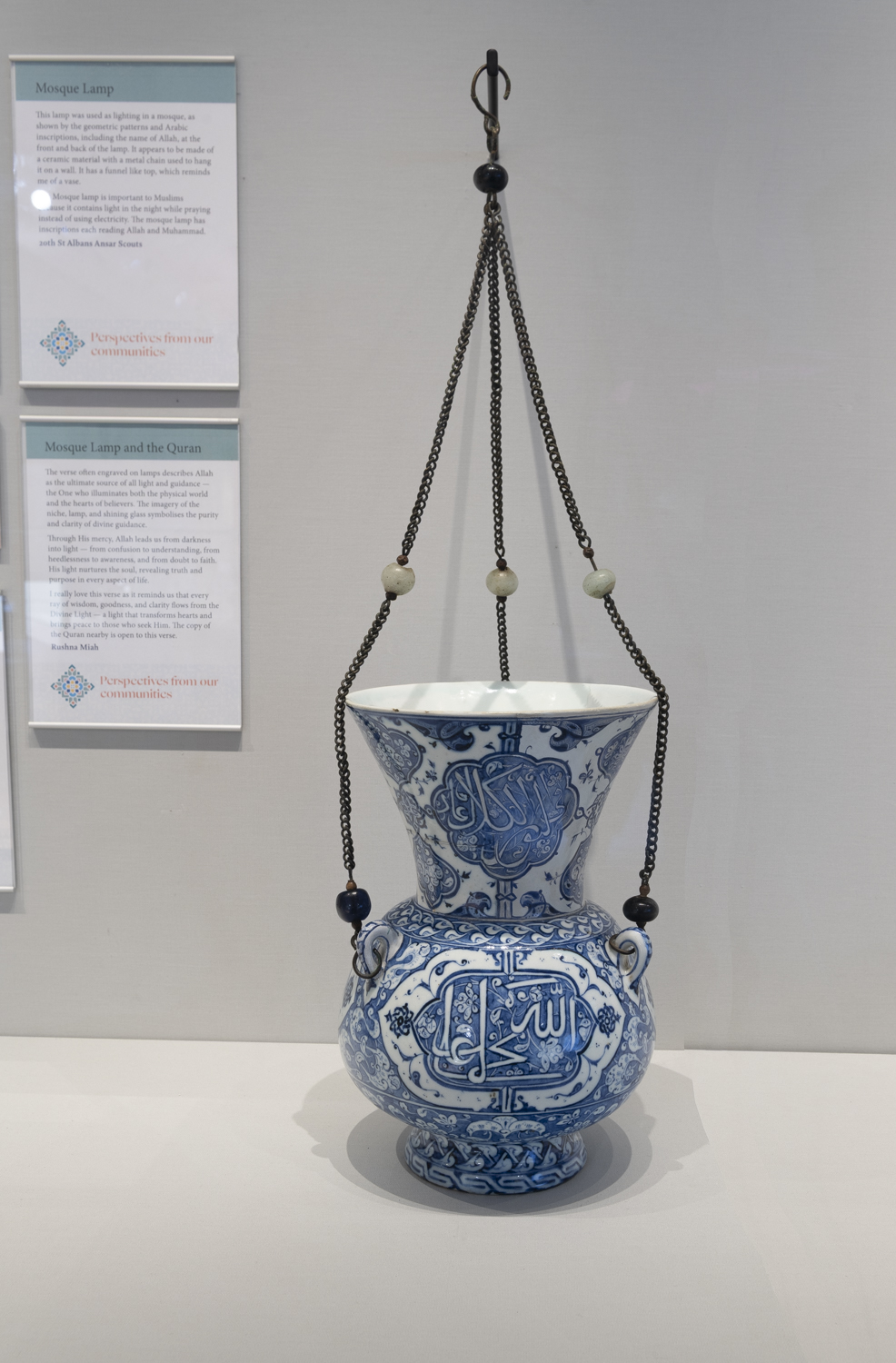
Mosque lamps, like this one, played a symbolic role as well as a practical one in lighting a mosque. Looking at this lamp, you can see it is ceramic and as such it would provide less light than glass or another clearer material.
In Islam, as in many religions, light is connected directly to Allah and the journey from darkness to light can be seen as the journey to enlightenment. Many mosque lamps are engraved with a verse from the Quran which begins
The Parable of His Light is as if there were a Niche and within it a Lamp the Lamp enclosed in Glass: the glass as it were a brilliant star. (Quran, 24:35)
This lamp was made in around 1510 in Iznik, in modern Türkiye. In the 1500s Türkiye was part of the Ottoman Empire which reached from Basra in modern Iraq to Buda in modern Hungary and also included parts of North Africa. It is similar in design to the lamps that were hung at the tomb of the Ottoman emperor Bayezid II.
Mosque Lamp Community Text
Mosque lamp
This lamp was used as lighting in a mosque, as shown by the geometric patterns and Arabic inscriptions, including the name of Allah, at the front and back of the lamp. It appears to be made of a ceramic material with a metal chain used to hang it on a wall. It has a funnel like top, which reminds me of a vase.
The Mosque lamp is important to Muslims because it contains light in the night while praying instead of using electricity. The mosque lamp has inscriptions each reading Allah and Muhammad.
20th St Albans Ansar Scouts
Mosque lamp and the Quran
The verse often engraved on lamps describes Allah as the ultimate source of all light and guidance — the One who illuminates both the physical world and the hearts of believers. The imagery of the niche, lamp, and shining glass symbolises the purity and clarity of divine guidance. Through His mercy, Allah leads us from darkness into light —from confusion to understanding, from heedlessness to awareness, and from doubt to faith. His light nurtures the soul, revealing truth and purpose in every aspect of life. I really love this verse as it reminds us that every ray of wisdom, goodness, and clarity flows from the Divine Light — a light that transforms hearts and brings peace to those who seek Him. The copy of the Quran nearby is open to this verse.
Rushna Miah
Samarra fragments
British Museum (OA+.11131)
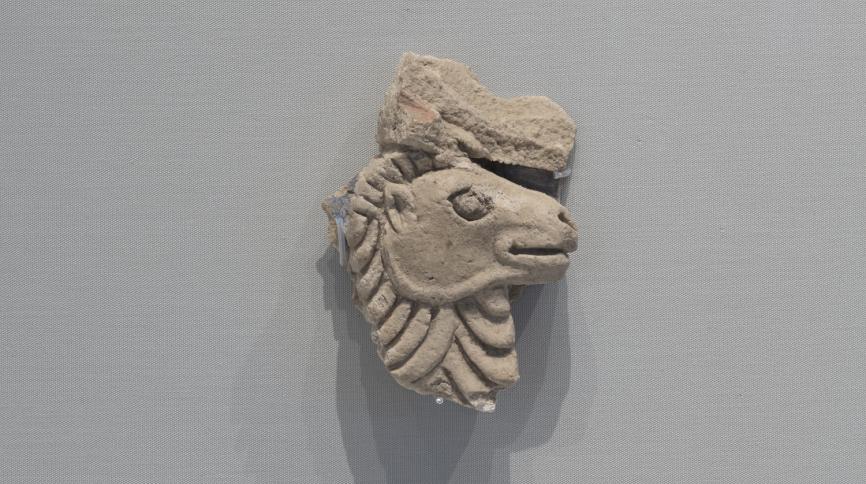
This fragment was chosen by our steering group because of its connection to the period known as the Anarchy at Samarra. Between 860 – 871 Samarra, then the capital of the Abbasid Caliphate, became the centre of a period of violence as four different Caliphs, each controlled by powerful military rivals, came to power in just 11 years. The Abbasid Caliphate (750 – 1258) is often seen as the Islamic Golden Age but as with all empires, the power that allowed for the flourishing of learning, architecture, science, religion and the arts also attracted enemies and rivals, especially from conquered regions and factions.
This fragment of gypsum plaster was excavated in Dar al-Khilafa, a palace in the ancient city of Samarra. It was made in around the 800s and a small amount of the cobalt blue background is still visible. You can also see a picture of some of the other fragments discovered by Professor Ernst Herzfeld during an excavation in 1907 and compare them with fragments of painted plaster from the Roman city of Verulamium.
Headwear
Made by the Saheli Women’s group
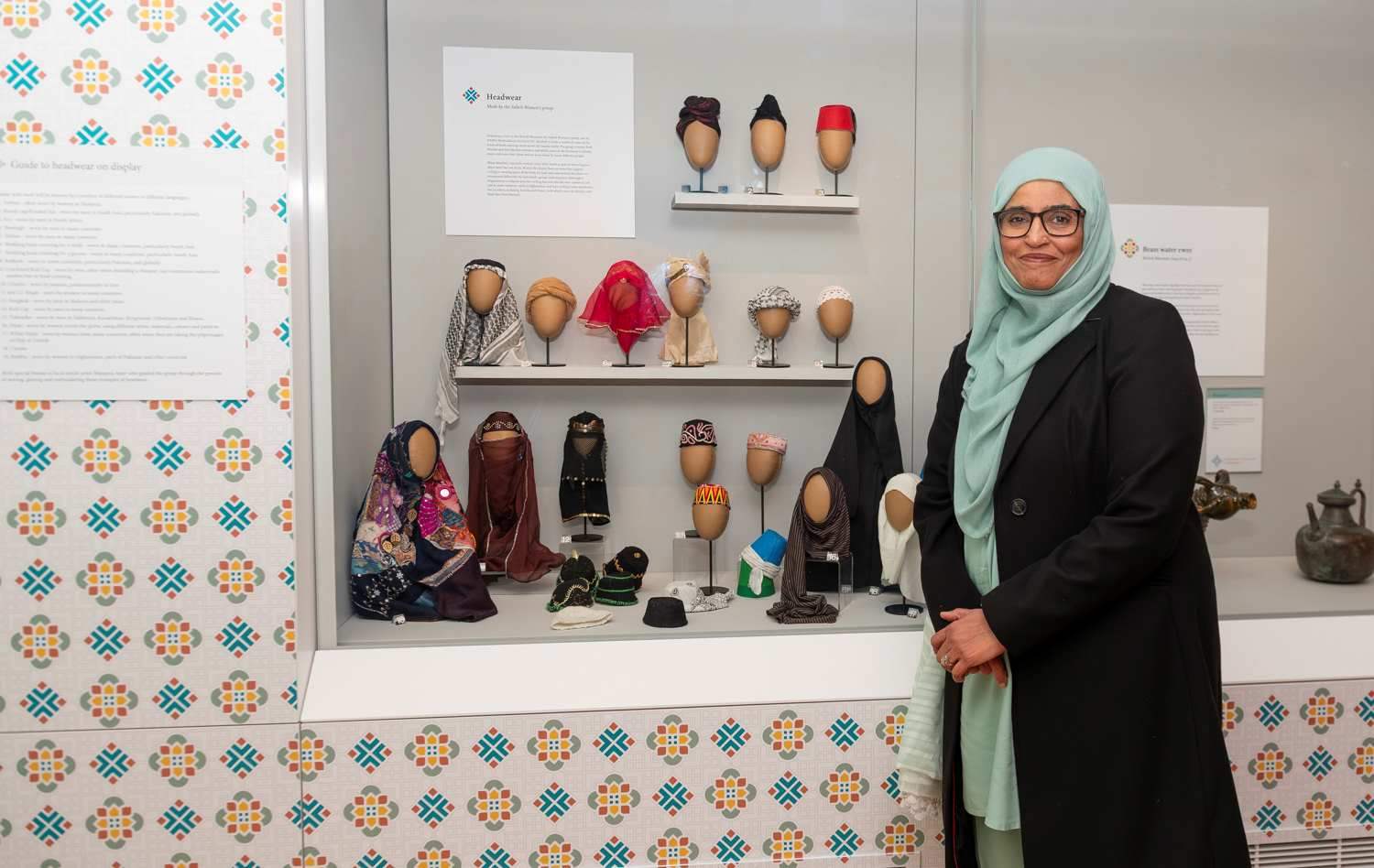
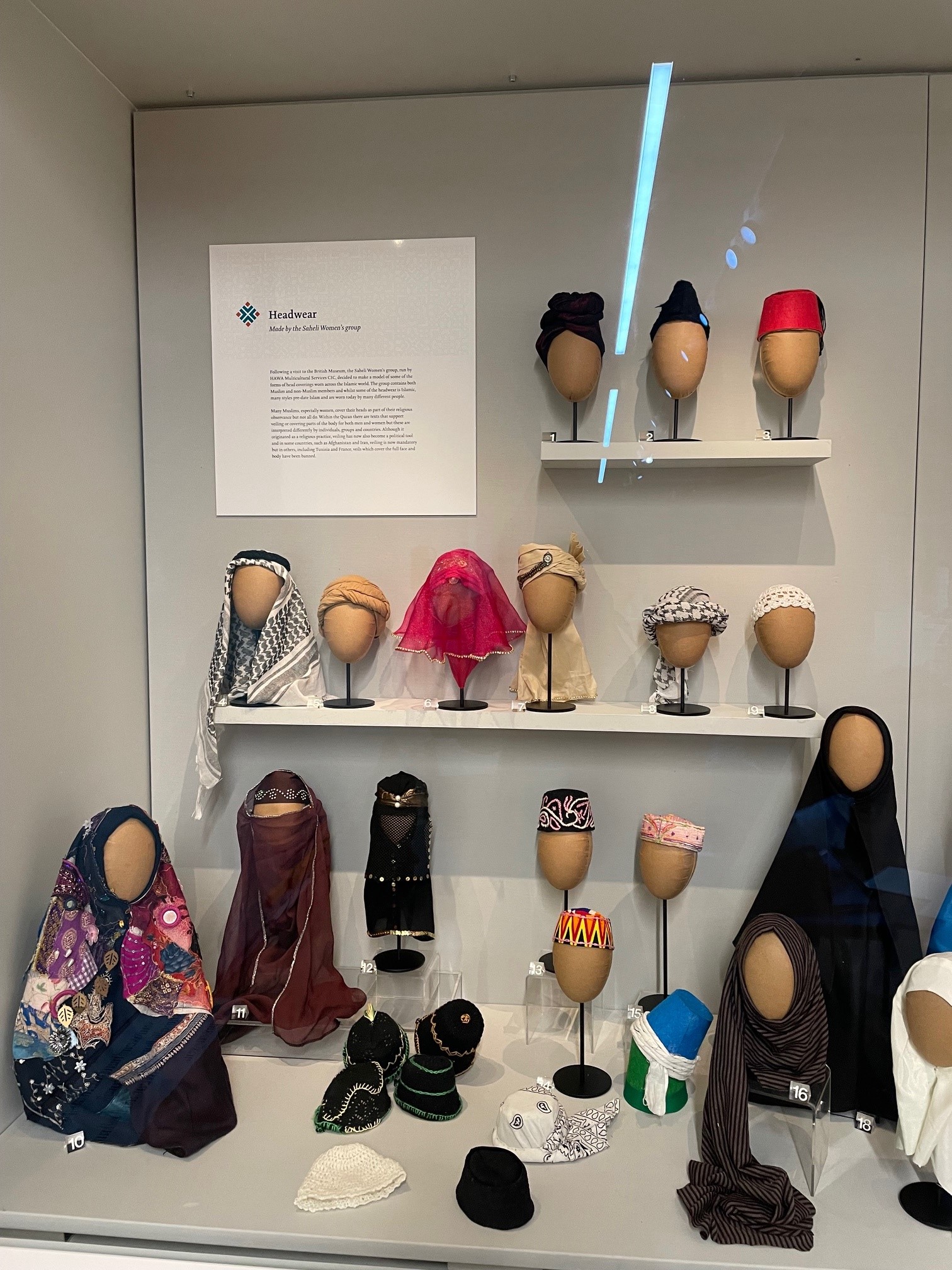
Following a visit to the British Museum, the Saheli Women’s group, run by HAWA Multicultural Services CIC, decided to make a model of some of the forms of head coverings worn across the Islamic world. The group contains both Muslim and non-Muslim members and whilst some of the headwear is Islamic, many styles pre-date Islam and are worn today by many different people.
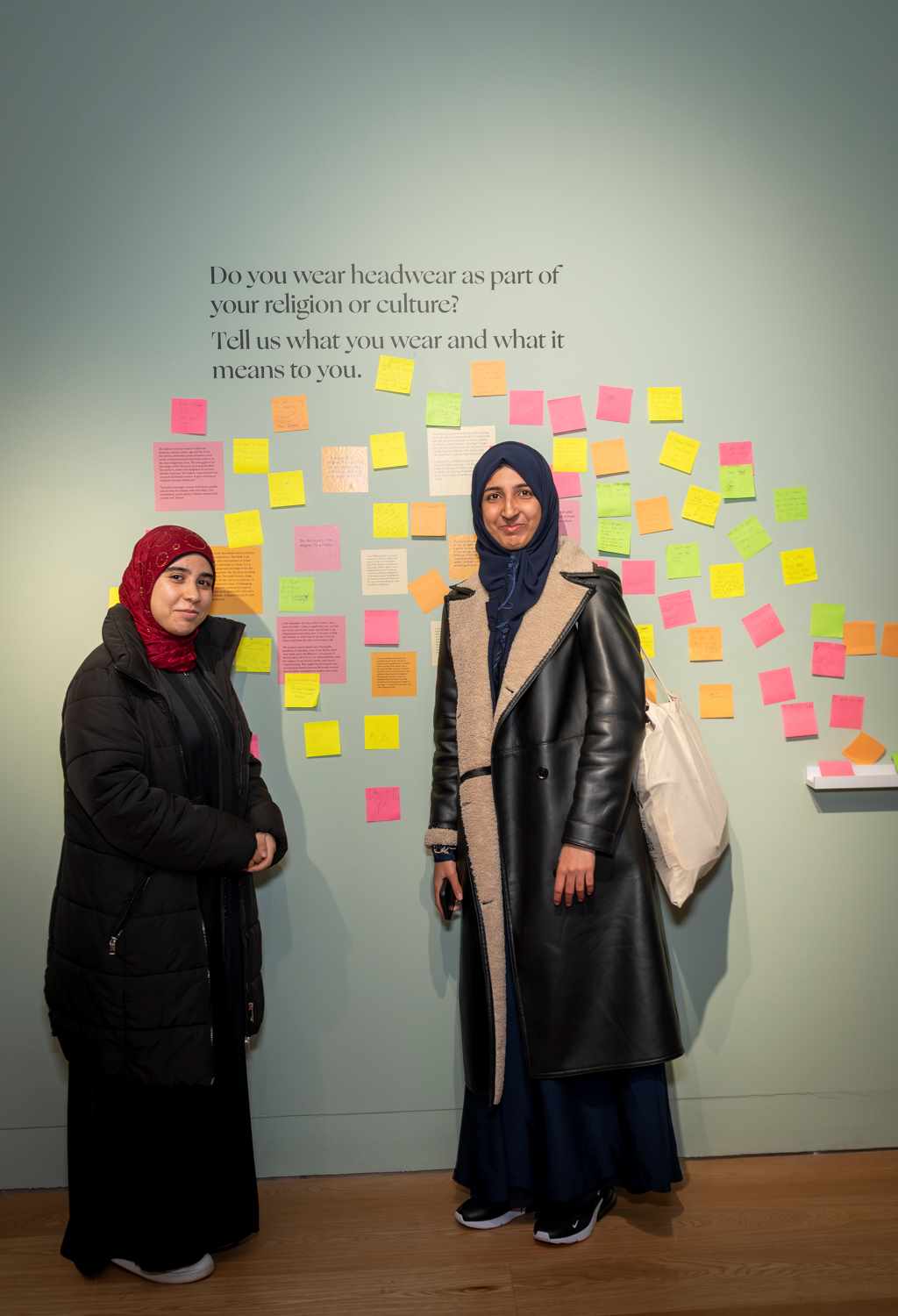
Many Muslims, especially women, cover their heads as part of their religious observance but not all do. Within the Quran there are texts that support veiling or covering parts of the body for both men and women but these are interpreted differently by individuals, groups and countries.
Although it originated as a religious practice, veiling has now also become a political tool and in some countries, such as Afghanistan and Iran, veiling is now mandatory but in others, including Tunisia and France, veils which cover the full face and body have been banned.
Huqqa or waterpipe
British Museum (1989,0731.1)
A huqqa (also known as a shisha and several other names) is a tool for heating or vaporising and then smoking substances including tobacco, mu’assel, hashish, opium and cannabis. Huqqa is a Hindustani word of Arabic origin referring to a bottle or waterpipe and the pipe base in this case is an eighteenth century example from Punjab in Pakistan.
The waterpipe first appeared in the 1560s in India and, although tobacco and drug use was either taboo or forbidden in much of the Islamic world, their use quickly spread. Huqqa or shishas can have double, triple or even quadruple hoses allowing smoking to be a social event in a café or other public space.
In Europe, tobacco and similar drugs were more commonly smoked directly rather than through waterpipes but it was also a social experience, just as a cigarette break may still be today. Despite the increasing evidence of the harm smoking of any kind can do, huqqa, cigarettes and new technologies such as vapes continue to be popular across the world.
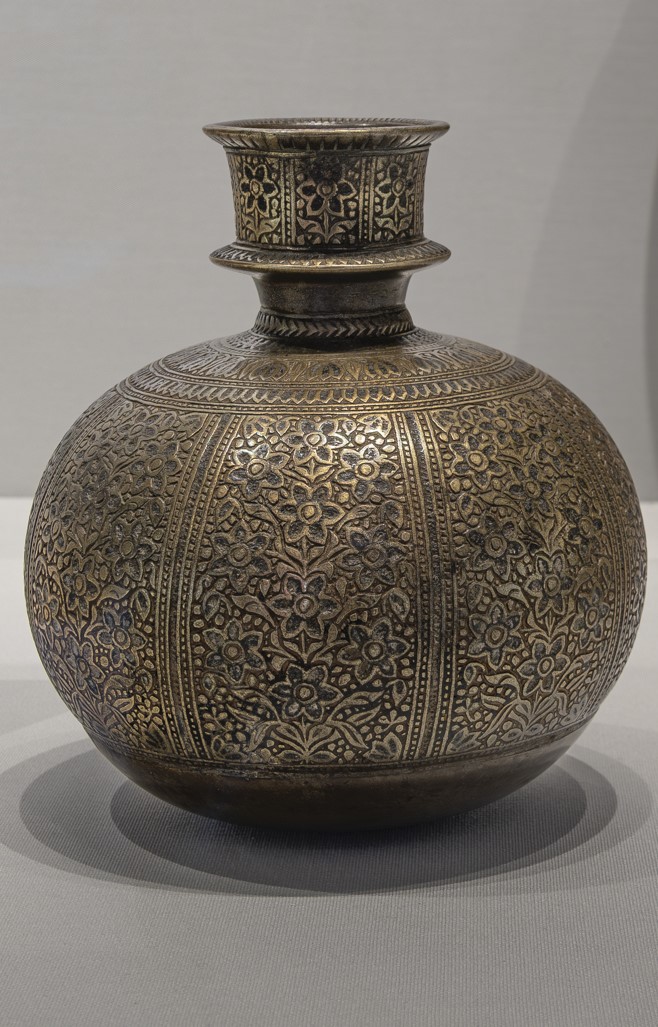
Huqqa Community Text
This reminds me of my parents’ house in the 1970s. They hadn’t been to India or Pakistan but they loved the whole hippy aesthetic, and liked to surround themselves with interesting and decorative objects. Lots of the decoration around the house was this type of brass engraved object – bells and small containers, and a huqqa pipe or two on the walls.
EC
I remember my grandfather in our village in Bangladesh, sitting on the veranda with his huqqa. He would fill it with tobacco and smoke as neighbours and friends gathered, chatting and sharing stories. The huqqa was more than just a smoking pipe – it was a centre of social life, bringing people together in conversation and community. Today, this tradition has been revived in the form of shisha and modern shisha lounges, which continue to serve as spaces for socialising and connection.
Rushna Miah
Astrolabe
The Whipple Museum of the History of Science, University of Cambridge
An astrolabe is a model of the heavens with earth at the centre. It can be used to measure the exact co-ordinates of the stars and carry out calculations. Each astrolabe plate is made for a specific latitude, so some come with several plates.
Astrolabes are one of many examples of scientific knowledge and instruments which travelled from the Greek and Roman world to the Islamic world, where it was developed and improved, before travelling back to medieval Europe.
During the Abbasid caliphate (750 – 1258), Baghdad became a centre of learning and the House of Wisdom, Bayt al-Hikmah, became a hub for the collection and translation of manuscripts from Greek, Persian and Indian writers. As they translated, some of the individuals also developed and improved on the ideas in the manuscripts from medicine to optics to astronomy.
This astrolabe was made in Persia (modern Iran) in the 1820s by M. Akhbar and the quadrant is from around the same period but probably originated around modern Türkiye.
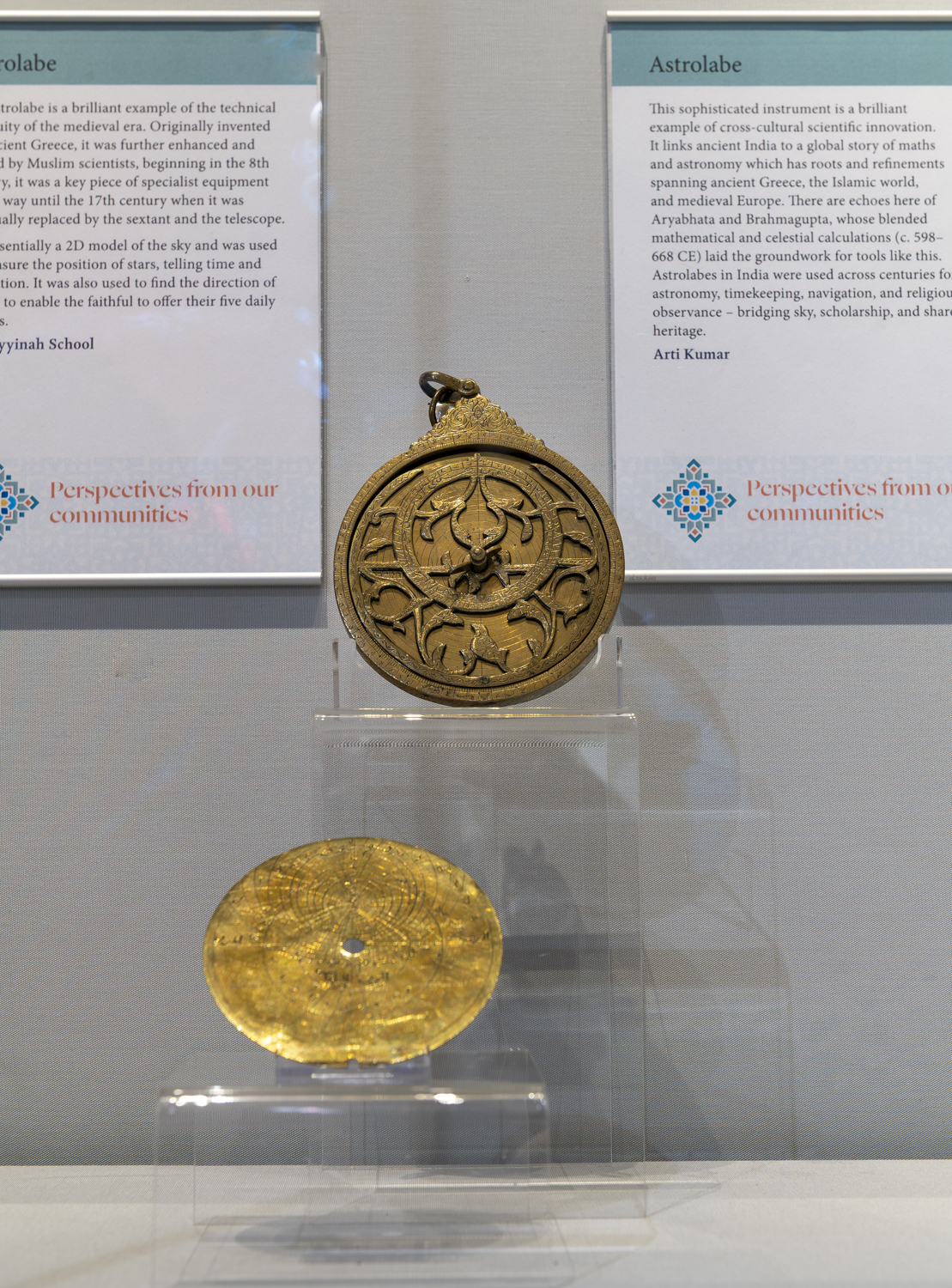
Astrolabe Community text:
The astrolabe is a brilliant example of the technical ingenuity of the medieval era. Originally invented in Ancient Greece, it was further enhanced and refined by Muslim scientists, beginning in the 8th century, it was a key piece of specialist equipment all the way until the 1600s when it was eventually replaced by the sextant and the telescope. It is essentially a 2D model of the sky and was used to measure the position of stars, telling time and navigation. It was also used to find the direction of Mecca to enable the faithful to offer their five daily prayers.
Al-Bayyinah School
This sophisticated instrument is a brilliant example of cross-cultural scientific innovation. It links ancient India to a global story of maths and astronomy which has roots and refinements spanning ancient Greece, the Islamic world, and medieval Europe. There are echoes here of Aryabhata and Brahmagupta, whose blended mathematical and celestial calculations (c. 598–668 CE) laid the groundwork for tools like this. Astrolabes in India were used across centuries for astronomy, timekeeping, navigation, and religious observance – bridging sky, scholarship, and shared heritage.
Arti Kumar
Comments from some of contributors to the exhibition:
Steering this exhibition has been a journey of rediscovery – of layered histories and unexpected friendships. Growing up in India, I was surrounded by multicultural traditions I barely noticed at the time: the blend of Hindi and Urdu in everyday speech, the tandoori flavours we relished, the salwar kameez I sometimes wore, and the songs I learned from Islamic musical genres. Seeing familiar objects in the British Museum’s Islamic collection reframed my understanding. What I saw as simply ‘Indian’ now revealed syncretic roots – cultural expressions stemming from open minds and open borders – knowledge, materials and techniques coming together in some of the most interesting and beautiful textiles, jewellery, art and architecture the world has ever seen. Interconnectedness isn’t just historical – it’s personal. It’s how we grow, how we belong, and how we connect our own stories with others who bring their own stories to the table.
Arti Kumar
I wanted to be part of this exhibition, the first of its kind in St Albans, to celebrate and share the rich contributions of the Islamic world to global culture and knowledge. It has been a real pleasure to work with the St Albans Museum, especially Eleanor, who has been fantastic — not only listening and engaging, but more importantly involving all communities and helping to co-create this project with the community, for the community. Through this exhibition, I hope to highlight the positive aspects of Islam, foster understanding, and celebrate the values and experiences we share with others.
Rushna Mia
This exhibition comes at an incredibly relevant time. Against a backdrop of rising polarisation and mistrust, this exhibition cuts through the misinformation and presents a view of history that is often missed. Showcasing examples of how our civilisations and cultures are far more interconnected than we might otherwise imagine, it shines a light on a forgotten past that has much to teach us today about mutual cooperation and shared origins.
Al-Bayyinah School
Scouting connects us to our faith as we get to experience Allah’s creation’s beauty firsthand. Being a scout helps us appreciate all that we have and take care of it. Scouting connects me to my faith because you are surrounded by other Muslims and you get to pray with everyone. You can learn about important figures and stories also learning more about our faith and use it in our everyday life.
20th St Albans Ansar Scouts